Posted on May 14, 2014 by Adrian Bryttan.
Original title: How Moscow Hijacked the History of Kyivan Rus.
(This essay was first published in a collection by Yaroslav
Dashkevych, PhD. History, “Learn to Speak the Truth with
Non-Lying Lips” – K:Tempora, 2011, 828pp)
In creating their nation, Ukrainians need to examine and
analyze their own history, based on truth, verified facts and
historical events. For centuries under the rule of conquerors,
Ukrainians were basically deprived of the opportunity to
influence the formation of national awareness and the the
development of their history, with the result that Ukraine’s
history was composed predominantly to the advantage of their
conquerors. Especially troublesome is the question of the
pretensions and demands of Moscow, and later Russia, concerning
the the historical legacy of Kyivan Rus.
Baptism of Rus-Ukraine 988 AD
In his historical work “The Land
of Moksel or Moskovia” (Olena Teliha Publishing House, Kyiv
2008, 2009, 3 vol.) V. Bilinsky presents historical sources (predominantly
Russian) which testify to the total misrepresentation of the
history of the Russian Empire, which was geared to create a
historical mythology about Moscow and Kyivan Rus sharing common
common historical roots, and that Moscow possesses “succession
rights” to Kyivan Rus.
Moscow’s outright fraud that appropriated the past of the
Great Kyiv kingdom and its people dealt a severe blow to the
Ukrainian ethos. Our obligation now is to utilize hard facts to
uncover the lies and amorality of Moscovian mythology.
Let’s examine these problems.
The tsars of Moscow and, later, Russia understood that
without an imposing past it was impossible to create a great
nation and empire. Therefore it was necessary to glorify their
historical roots and even to hijack the history of other nations.
So, starting with Ivan the Terrible (1533-1584) the tsars of
Moscow applied all their efforts to appropriate the history of
Kyivan Rus, its glorious past, and to create an official
mythology for the Russian Empire.
This might have been less consequential if their mythology had
not affected the central concerns of Ukraine and if it had not
aimed at the utter destruction of Ukraine: its history, language
and culture. Over time, it became clear that Russian Imperial
chauvinists did and continue to do everything possible to
realize this aim.
Over hundreds of years and especially starting with the early
XVI century, they brainwashed and continue to brainwash
everyone, saying that the origins of the Russian nation and
people are the Great Kyivan kingdom. They assert that Kyivan Rus
was the cradle of three sibling nations – Russians, Ukrainians
and Belarus; and that because the Russians are “older brothers”,
they have the right to the legacy of Kyivan Rus. To this day,
Russian historians and officials make use of this woeful lie,
which is repeated by the ‘fifth column’ of communists and almost
all Party of Regions deputies in our Parliament.
Myth of Three Brotherly Nations – in the place of modern
Moscow, non-Slavic tribes reside while the territory of
Ukraine and Belarus is inhabited by Slavic peoples
Here are the facts:
At the time of the Kyivan Empire there was no mention of
a Moscow nation. It is well known that Moscow was created in
1277 as a subservient vassal region or ‘ulus’ to the Golden
Horde, established by the Khan Mengu-Timur. By that time,
Kyivan Rus had existed for more than 300 years.
There are no indications of any connection of Kyivan Rus
with the Finnish ethnic groups in the land of ‘Moksel’ or
later of the Moscow principality with the Principality of
Kyivan Rus up until the XVI century. At the time when Kyivan
Rus had officially accepted Christianity, the Finn tribes in
‘Moksel’ lived in a semi-primitive state.
How can anyone speak of ‘an older brother’ when that ‘older
brother’ did not first appear until centuries after
Rus-Ukrainians? He has no moral right to call himself an ‘older
brother’, nor to dictate how people are to live, nor to force
his culture, language, and world views. It is clear that until
the end of the XV century, there was no Russian nation, there
was no older brother ‘Great Russian’, nor were there any Russian
people. Instead, there was the land of Suzdal: the land of
Moksel, later the Moscow princedom, which entered into the role
of the Golden Horde, the nation of Genghis Khan. From the end of
the XIII to the beginning of the XVIII century, the people in
this land were called Moskovites. And Moscow historians are
silent about this question of their national origins.
Moskovites, Big Russians –
who are they?
Moskovites. During the IX to the XII cent.
the large area of Tula, Riazan, and today’s Moscow region,
including the tribes of Mer, Ves, Moksha, Chud, Mari and others
– all this was inhabited by the people called ‘Moksel’. These
tribes eventually became the foundation of the nation who now
call themselves ‘Great Russians’.
In 1137, the younger son of the Kyivan prince Monomakh, Yuri
Dolgoruky (who had been left without a princedom in the Kyivan
empire) arrived in this land.
Yuri Dolgoruky
Yuri Dolgoruky began the rule of the ‘Riurykovyches’ in
‘Moksel’, becoming prince of Suzdal. To him and a local Finnish
woman was born a son Andrey, called ‘Bogoliubsky’. Born and
raised in the forest wilderness among the half savage Finnish
tribes, prince Andrey cut all ties with his father’s entourage
and with their old Kyivan customs.
In 1169 Andrey Bogoliubsky sacked and destroyed Kyiv. He
destroyed all the churches and religious artifacts, something
unheard of in those times.
Andrey Bogoliubsky
Andrey was a barbarian who did not feel any familial ties
with Kyiv, the holy city of Slavs.
Within a brief time (50-80 years) every Finnish tribe was
imposed with a prince of the Riurykovyches, whose mother was
either a woman of Mer, Murom or Kokshan… Thus appeared the
‘Moksel’ princedoms: Vladimir, Riazan, Tver, and others. At this
time, some missionaries appeared in the land of Moksel to spread
Christianity. It is impossible to consider a mass ‘migration’ of
Slavs from the Dnipro river region, as Russian historians
insist. Why should the Slavs leave behind their fertile Dnipro
lands and relocate more than a thousand kilometers through
impassable undergrowth and swamps into an unknown semi-savage
land?
Under the influence of Christianity, the land of ‘Moksel’
started to form their language, which in time became Russian. Up
until the XII century, only Finn tribes lived in the land of
‘Moksel’. The archaeological findings of O.S. Uvarova (Meria
and their everyday life from kurhan excavations, 1872 – p.
215) support this. Out of 7729 excavated kurhans, not a single
Slavic burial was discovered.
And the anthropological investigations of human skulls by A.
P. Bohdanov and F. K. Vovk support the differentiated
characteristics of the Finnish and Slavic ethnoses.
In 1237 the Tatar-Mongols entered the lands of Suzdal. All
who bowed, kissed the boots of the Khan and accepted
subservience remained alive and unharmed, all others who did not
submit were destroyed.
Moscow’s Subserviance to the Khan
The princes of Vladimir, Yury and Yaroslav Vsevolodovich
accepted subservience to Khan Batey. In this manner, the land of
‘Moksel’ entered the ranks of the Golden Horde Empire of Genghis
Khan, and its fighting forces were combined with the army of the
Empire. The commander of the Moksel division within Batey’s army
was Yury Vsevolodovich, the prince of the city of Vladimir. In
1238, Finnish tribe divisions were formed and marched together
under Batey in his invasions of Europe in 1240-1242. This is
direct evidence of the establishment of the rule of the Khan in
the lands of Rostov-Suzdal.
While Yuri Vsevolodovich was away taking part in Batey’s
European invasion, his younger brother Yaroslav Vsevolodovich
was placed at the head of the Vladimir princedom. Yaroslav left
his eight year old son Alexander Yaroslavich as hostage with the
Khan.
Alexander “Nevsky” blood brother with Khan Sartak of the
Golden Horde
Living with the Horde of Batey from 1238 to 1252 Alexander,
only much later named ‘Nevsky’, adopted all the customs and
organizational ideas of the Golden Horde. He became a blood
brother of Sartak, the son of the Khan, married the Khan’s
daughter, and eventually became a loyal vassal of the Golden
Horde and prince of Vladimir from 1252 to 1263. He never took
part in any significant battles – all the ‘victories’ of
Alexander Nevsky are transparent lies. Prince Alexander simply
could never had taken part in the battles on the Neva in 1240
and on Chud or Peipus Lake in 1242 (fantasized in Eisenstein’s
film) because he was still a child.
It is important to mention that the ruling powers of the
local princes of Rostov-Suzdal were minimal. Khan Batey
installed his own administrators in all the “ulus” princedoms:
on top was the Great Baskak, and under him were the regional
administrative baskaks.These
were full-fledged rulers from the Golden Horde, who followed the
laws of the Genghis Khans. Russian historians are lying when
they state that the princes of Suzdal, and later Moscow, were
independent from the Golden Horde. The Khan’s covenant named the
primary rulers of the princedoms his baskak, or ‘daruha’, while
the local princes were relegated to second and even third place
importance.
The big lie was introduced: that Moscow was founded in 1147
by Yuri Dolgoruky. This is a myth with no supportive evidence.
Moscow was established as a settlement in 1272. That same year
the Golden Horde conducted their third census of the populations
in their domain. Both in the first census (1237-1238) and in the
second census (1254-1259) there is no mention of any Moscow at
all.
Moscow appeared as a princedom in 1277 at the decree of the
Tatar-Mongol Khan Mengu-Timur and it was an ordinary ‘ulus’
(subdivision) of the Golden Horde. The first Moscow prince was
Daniel (1277-1303), younger son of Alexander, so-called
‘Nevsky’. The Riurykovich dynasty of Moscow princes starts from
him. In 1319 Khan Uzbek (as stated in the afore-mentioned work
by Bilinsky) named his brother Kulkhan the virtual Prince of
Moscow, and in 1328 the Great Prince of Moscow. Khan Uzbek
(named in Russian history as Kalita), after he converted to
Islam, destroyed almost all the Riurykovich princes. In
1319-1328 the Riurykovich dynasty was replaced by the Genghis
dynasty in the Moscow ‘ulus’ of the Golden Horde. In 1598 this
Genghis dynasty in Moscow which began with Prince Ivan Kalita
(Kulkhan) was finally broken. Thus for over 270 years, Moscow
was ruled solely by the Khans of Genghis.
Still, the new dynasty of the Romanovs (Kobyla) promised to
follow former traditions and solemnly swore allegiance to the
age-old dynasty of Genghis.
In 1613 the Moscow Orthodox Church became the stabilizing
force to safeguard the sustainment of Tatar-Mongol government in
Moscow, offering Masses for the Khan, and issuing anathemas on
anyone who opposed this servitude.
Based on these facts, it becomes clear that Moscow is the
direct inheritor of the Golden Horde Empire of Genghis and that
actually the Tatar-Mongols were the ‘godfathers’ of Moscow
statehood. The Moscow princedom (and tsardom from 1547) up until
the XVI century had no ties or relationships with the princedoms
of the lands of Kyivan Rus.
Great Russians. The tribe of Great Russians,
or the Russian people as known today, appeared around the XV to
XVII centuries from among the Finn tribes: Muroma, Mer, Ves and
others. This was when their history started. There is no history
of Great Russians on Kyivan lands! The history of Great Russians
starts with the ‘Beyond the Forests Land’ in Moscow, which was
never Kyivan Rus. The Tatar-Mongols who entered these lands were
a big element in the formulation of ‘Great Russians’. The Great
Russsian psychology absorbed many characteristics - the
Tatar-Mongol instincts of a conqueror and despot, with the
ultimate aim: world domination. Thus by the XVI cent. was
established the type of a conqueror who was horrible in his lack
of education, rage and cruelty. These people had no use for
European culture and literacy. All such things like morality,
honesty, shame, justice, human dignity and historical awareness
were absolutely foreign to them. A significant amount of
Tatar-Mongols entered the makeup of Great Russians from the XIII
to XVI centuries and they accounted for the genealogy of over
25% of Russian nobility. Here are some Tatar names that brought
fame to the Russian Empire: Arakcheev, Bunin, Derzhavin,
Dostoyevsky, Kuprin, Plekhanov, Saltykov-Shchedrin, Turgenev,
Sheremetiev, Chadaev and many others.
Ivan Turgenev
In order to appropriate the history of Kyiv lands and to
immortalize this theft, the Great Russians had to squash the
Ukrainian people, drive them into slavery, deprive them of their
true name, exterminate them via famine, etc.
Ukrainians had emerged as a nation in the XI to XII
centuries, and probably, even earlier. Later they were labeled
‘Little Russians’ when Russians began to brainwash the world
with their ‘version’ of history. For the smallest deviation from
this official version, people were tortured, killed, and sent
off to the GULAG. The Soviet period was especially brutal and
vicious. During that time, Ukraine lost over 25 million of her
sons and daughters, who perished in wars for Russian interests,
and during collectivization, tortures, and forced relocations.
This is the way the ‘older brother’ forced the ‘younger
brother’, the ‘Little Russian’, to live in the savage ‘embraces
of love’.
Creation of the Historical Myth of the Russian State
Back in the times of the princedom of Vasily III (1505 –
1533) Moscow gave birth to the idea of its greatness,
articulated by the representative of Moscow orthodoxy, the monk
Filofey: “Two Romes fell, a third still stands, and there will
never be a fourth”.
Filofey of Moscow
From there, they created the idea of an all-powerful and ‘God
chosen’ Moscow – the ‘third – and final Rome’. These ideas
spread and were confirmed throughout Moskovia. And how much
blood was spilt by the princes of Moscow, and later the tsars,
over this fantasy-myth!
During the reign of Ivan IV (the Terrible) they grasped not
only after the inheritance of Kyivan Rus, but now also the
Byzantine Empire. Thus, according to accounts, the cap of
Monomakh was believed to have been given the Kyivan prince
Volodymyr Monomakh by his granddad, the basileus Constantine IX.
“Cap of Volodymyr Monomakh”
This was considered the symbol of the transfer of power from
Byzantium to Kyivan Rus. In addition, Yuri Dolgoruky, the sixth
son of Volodymyr Monomakh, was the first prince of Suzdal,
so the appearance of this cap in Moscow was a ‘proof’ of the
legacy legitimacy of the Moscow rulers not only to the Kyiv
Great Throne, but now also to the inheritance of the former
Byzantine Empire. Furthermore, Moscow fabricated a deceptive
last will of Volodymyr Monomakh about handing over ‘legacy
rights’ to his son Yuri Dolgoruky, the conqueror of the
so-called ‘Beyond the Forests Land’. This was all fiction. In
reality, the cap of Monomakh was a gold ‘bukhar tubeteyka’,
which Khan Uzbek presented to Ivan Kalyta (1319-1340) who
maintained this cap in order to further his fame.
(Логвин Ю. Кобила, Калита і
тюбетейка «Мономаха» // Час. – Київ, 1997, 27 березня).
Ivan Kalyta
Ivan IV (the Terrible) in 1547 was anointed in the cathedral
with the title of ‘Moscow Tsar’ as the ‘inheritor’ of the Greek
and Roman emperors. Of the 39 signatures who affirmed this
document sent from Constantinople, 35 were forgeries. Thus, Ivan
the Terrible became the ‘inheritor of the Byzantine emperors’.
Thus, the lie was made official.
Ivan IV, the Terrible
Peter I began the massive falsification of his people’s
history. In 1701 he issued a decree to eliminate from all
subjugated peoples all their recorded national historical
artifacts: ancient chronicles, chronographs, old archives,
church documents etc. This was especially directed at Ukraine-Rus.
In 1716, Peter I ‘changed the copy’ of the so-called
Königsberg Chronicles to now show the ‘joining’ of the old
chronicles of the Kyivan with the Moscow princedoms. The aim was
to lay a foundation for the unity of Slavic and Finnish lands.
However, both the false ‘copy’ as well as to the original were sealed.
Peter I, the Great
Peter’s falsification became the basis for further
falsifications – the composition of the so-called ‘General Rus
Chronicles Collections’ which purported to establish Moscow’s
rights to the legacy of Kyivan Rus. On the basis of these
falsifications, on October 22, 1721, Moscow proclaimed itself
the Russian Empire, and all Moskovites were now to be – Russians.
In this manner, they stole from the legitimate inheritors of
Kyivan Rus the Ukrainians’ historical name of Rus.
Peter imported from Europe a large number of specialists,
including professional historians, who were assigned the
rewriting and falsification of the history of the Russian state.
In addition, every foreigner who entered government work,
swore an oath not to reveal state secrets and to never betray
the Moscow state. The question remains, what government secrets
regarding the ‘formation of Russian history’ of ancient times
could there be? In any civilized European country, after 30-50
years all archives are opened. The Russian Empire is very afraid
about the truth in its past. Deathly afraid!
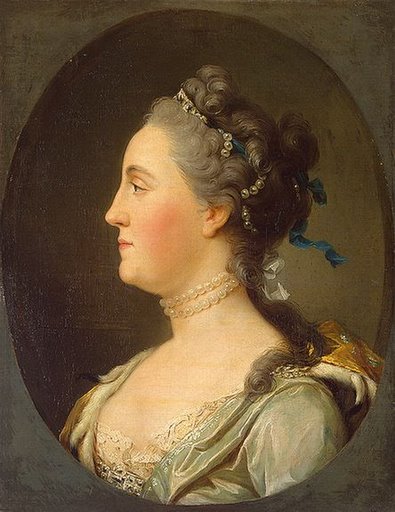
Following Peter I, who transformed Moscow into the Russian
state, the Moscow elite began to consider the necessity of
creating a comprehensive history of their own country. Empress
Catherine II (1762-1796) intensively took on this task.
Catherine II
She could not admit the idea that common Tatar-Mongol
elements existed in the dynasty of the Tsars. Catherine was an
intelligent and educated European woman and once she had
examined the archival sources, she called attention to the fact
that all the history of her country was based on oral traditions
(‘bilyny’) and had no factual support.
Therefore on December 4, 1783, Catherine II issued a decree,
creating a ‘Commision for the Collection and Organization of the
Ancient Russian History’ under the leadership and oversight of
Graf A. P. Shuvalov, with a staff of 10 renowned historians. The
principal task before this commission was to ‘find’ new
chronicles, rewrite others, and create new collections of
archives and other similar falsifications. The aim was to lay
the foundations for the ‘legitimacy’ of Moscow’s hijacking of
the historical legacy of Kyivan Rus and to create an official
historical myth about the origins of the Russian state. This
commission labored for ten years. In 1792, ‘Catherine’s History’
saw the light of day. The commission worked in the following
manner:
- the gathering of all written documents (archives,
chronicles, etc). This effort had partly begun under Peter I.
This collection of materials was conducted not only within the
Empire, but also from other countries like Poland, Turkey etc.
- the analysis, falsification, rewritings or destruction of
historical materials. Thus they rewrote the chronicles: ‘The
Tale of Ihor’s Campaign’, ‘Tale of bygone years’, ‘Lavrentiivsky
Chronicles’, and many others. Many chronicles were rewritten
several times, and the originals either locked up or destroyed.
Thus were also locked up: the ‘History of the Scythians’ by A.
I. Lyzlov (published in 1776 and 1787), and the ‘Russian History
from Ancient Times’ by V. M. Tatishchev (published in 1747). In
his ‘Scythian History’ Lyzlov showed that the inhabitants of
Moscow were a separate people, who had nothing in common with
Kyivan Rus, Lithuania, Poland, etc.
- the writing of new ‘Rus Chronicles Collections’ which were
now being composed in the XVIII cent., but purported to be from
the XI to the XIV centuries. These collections all propagated
the ‘General Rus’ idea. This was in reference to the times when
Kyivan lands were inhabited by Slavic tribes (Poliany,
Derevliany, Siveriany etc) who were Christians, while the
‘Beyond the Forests Land’ was populated by Finn tribes (Muroma,
Mer, Ves, Moksha and others) who lived a semi-primitive
existence, and these tribes had nothing historical in common up
to the XVI century.
- the new composition of thousands of various collections to
establish the ‘unity’ of Kyivan Rus with the Finn tribes. All
these chronicles and collections, according to author Bilinsky,
exist only in the form of copies, not one original. Not one! All
this points to the almost unbelievable in scope and shameless,
massive plundering and falsification of the creation of the
history of the Russian state.
It is impossible to live a lie forever!
It is time for Ukrainian historians to write the actual true
history of Ukraine, which would not be based on the lies of the
‘Catherine Chronicles’, the falsifications and newly written in
the XVIII century ‘General Russian Chronicle Collections’, but
rather based on historical reality, established in documents,
especially those preserved in countries like Poland, Turkey,
Greece, Iran and others. People deserve to know the truth.